Thursday, February 6, 2014

Wintery Zion and Eagle Crags

Last January (2013) while living in Kanab, Utah, I had a free day to just get out and explore. The options were plentiful, but it had been a while since taking a Zion trip. I decided it would be wise to go check out Zion's low elevation southwestern end, since the recent cold, snowy conditions had probably left many of the Park's trails very slick and icy. 

I drove through the Park's eastern entrance, through the tunnel, and down the windy road that drops down towards the canyon floor. At one of the road's bends, I stopped at a pullout and took an unmarked trail that followed a frozen creek. Up ahead, I noticed some impressive icicles draping off the rock face.

Frozen river with icicles in the background:


The closer I got to the icicles, the more impressed I became.


 I didn't dare get much closer than this:


Although probably pretty common, the icicles were a first time Zion observation for me. I stood around in awe for quite a while before retracing my steps (only about a hundred yards) to my car.

Another look at the creek:


I hopped back in the car, impressed with my unexpected discovery and continued towards the southwest entrance. 


After studying my Zion area map, I decided to head out the Eagle Crags trail, just south of the town of Rockville on BLM land. "Eagle Crags" refers to the obvious rock formations in this area. I did no research and knew very little about the trail, but why not check it out?

The road accessing the trailhead was pretty rough, and probably should only be attempted by high clearance vehicles, preferably with 4-wheel drive. My Xterra didn't have much trouble, but I took it pretty slowly. For further directions to the trailhead, click HERE

When I reached the trailhead, the Crags were looming large to the south.


The trail begins fairly flat before rising towards Eagle Crags and into the Canaan Mountain Wilderness. 

The views along the way were awesome, and offered glimpses to the east towards Zion's seldom visited Parunuweap Canyon (East Fork of the Virgin River.)

Parunuweap is the Canyon directly beyond the pond in this photo, between Johnson Mountain (left) and Shunesburg Mountain (right): 


Another view, panning to the left:


As the trail ascended towards the Eagle Crags, it became progressively snow-covered, until I eventually reached an area where only one other person had been up there since the last storm. 

I followed their boot prints until I was directly beneath the Crags.


I finally reached the area where the prints I had been following stopped, stepped off for a view, and turned around. This was also where the obvious trail ended, but I wasn't quite ready to turn around. 

I continued trudging across the now unbroken snow until I was pretty much bushwhacking through junipers and scrambling across rocks. In the distance I could see some rugged peaks deep in the heart of Canaan Mountain. Apparently there's a way to navigate from Eagle Crags to or from Water Canyon near Colorado City, Arizona. I decided on a stopping point and scouted out the terrain. It seems like that would be a gnarly navigation, but a challenge I'd be open to attempting. 

Here's my photo of the rugged peaks in the distance (sorry for the poor quality, the glare was pretty bad.)

I retraced my steps quickly, as I didn't want to run out of daylight, but I made a point to turn around and get one last glimpse of the Eagle Crags.


While driving back home, I decided to take the "scenic route" across Smithsonian Butte, which runs 9 miles from Grafton to Colorado City. This is a dirt road that was pretty rough in a few areas, but that didn't stop a couple of low clearance sedans from attempting it. One of these cars was at the top of a really muddy and steep stretch of road, and I saw no people in or around the car. I was amazed if they made it up that section (which I was a bit nervous going up with my Xterra in 4-wheel drive). Maybe more likely, they came from Colorado City and stopped when they saw what they were in for before dropping into Grafton. Either way, I'll never know.

It was my first time driving across Smithsonian Butte, and I was happy I went back that way. The sun was beginning to set, and I couldn't help but get out and snap a few pics as I made my way home. It was a great way to end a gorgeous winter day exploring the desert.


West side of Eagle Crags:


Friday, January 24, 2014

Zion Narrows

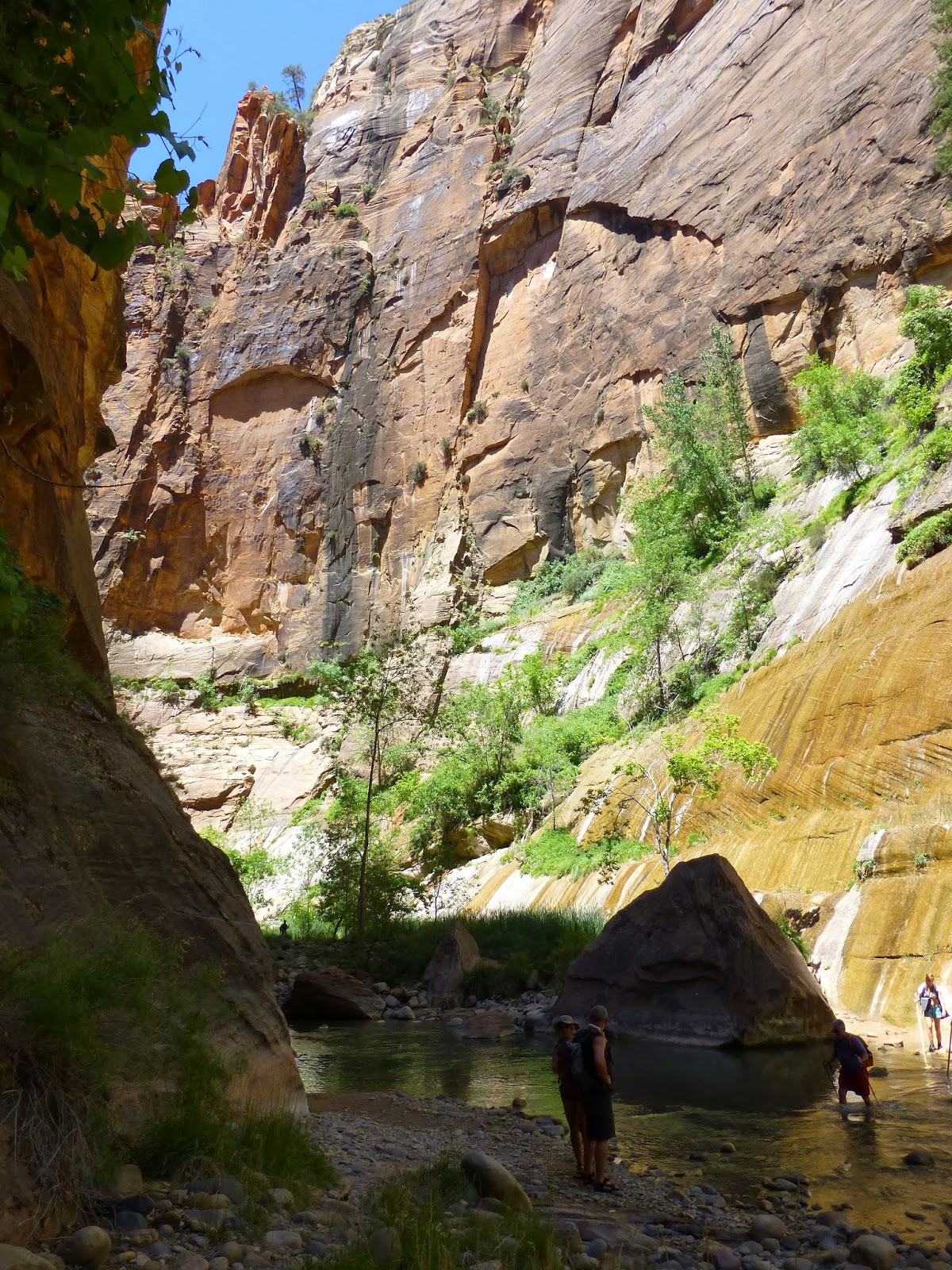
Recognized as one of the most spectacular slot canyons in the world, the hike through the Zion Narrows offers a different type of hiking experience than what many people are used to. There are two different ways to approach this hike. The most popular (and the only way I've done it) is the approach from the "bottom up." This starts from the Temple of Sinewava - the furthest point you can drive up Zion Canyon. This is most often done as a day hike. The other option is the "top down" approach, which is a one-way shuttle trip and requires a backcountry permit. This 15.5 mile overnight trip is the way to go if you're adventurous and looking for the full narrows experience, all while avoiding the crowds. I have yet to explore the narrows from the top down, but it's high on my Zion "to do" list.

Whichever way you're hiking the narrows, prepare yourself to get wet, which can be a refreshing change in the heat of the summer. The hike requires wading through pools, sometimes up to chest deep (depending on the time of year.) Hiking along the slippery and uneven river bottom is also a necessity, so trekking poles or hiking sticks are helpful. The Narrows shouldn't be attempted by anyone without a wet suit from November through May, due to cold water and high spring flows. 

Do your research, come prepared, and most importantly, have fun exploring one of the most spectacular slot canyons around!


Here are my photos from an August 2012 Narrows trip:


While hiking out of The Narrows and back to the trailhead, we saw a group of people gathering around something on the side of the trail. As we got closer, it became obvious what was drawing the attention. 
The rattlesnake seemed pretty distressed due to all the attention it was drawing, and had backed itself into a corner. Luckily, there was a ranger about a hundred yards down the trail who we notified about the situation. Hopefully she was able to move people along so the snake could go on its way.

I always enjoy wildlife sightings on my trips, rattlesnakes included. I've met some people who despise snakes and would willingly kill rattlesnakes, even if they aren't causing them any imminent danger. This is a mindset that I strongly disagree with. I have encountered several rattlesnakes over the years, and have never felt threatened. Even if you don't like snakes, let's respect these creatures and not be so shocked or outraged when we see them! Remember, we are in their habitat, not the other way around!

The Narrows is a place that most people in decent physical condition can enjoy, and it provides the versatility of a short day hike or a long overnight adventure. Best of all, it provides an escape from the heat of the summer. Don't forget to make The Narrows a part of your next summer trip to Zion! 

Friday, January 10, 2014

Observation Point

It's quite possible that the best day hike in Zion is the trek to Observation Point. At the top, it offers vast, sweeping views of Zion Canyon and beyond. The views are every bit as good as the more popular Angels Landing, but you have to work a little bit harder to get them, with 2100 feet of elevation gained in 4 miles. This hike also doesn't require the same exposure to steep drop-offs that turns some away from Angels Landing, so if you're in good shape but not overly fond of heights, Observation Point might be the better choice. The following description is from my hike in late September of 2011.
The Observation Point trail is accessed at the Weeping Rock trailhead and immediately starts climbing as switchbacks rise into shaded Echo Canyon and its towering, streaked sandstone walls. Echo Canyon itself would be a nice destination for those who don't have the time or ability to continue all the way to Observation Point. Echo Canyon is also one of the only shaded parts of the hike, so it might be a good place to rest before tackling the switchbacks that are soon to follow.

Echo Canyon:


After about 1.5 miles of enjoying Echo Canyon's relatively flat terrain, the trail reaches a junction with the East Rim Trail and access to Cable and Deertrap Mountains (hiking to these areas would best be done as a overnight trip.) Staying left at this junction takes you to Observation Point. This marks about the halfway point of the hike, but the majority of the elevation has yet to be conquered.

The rest of the hike is mostly all uphill with many switchbacks. The last half-mile becomes more gradual as you reach the top of the rim, and make your way towards the views that soon await.

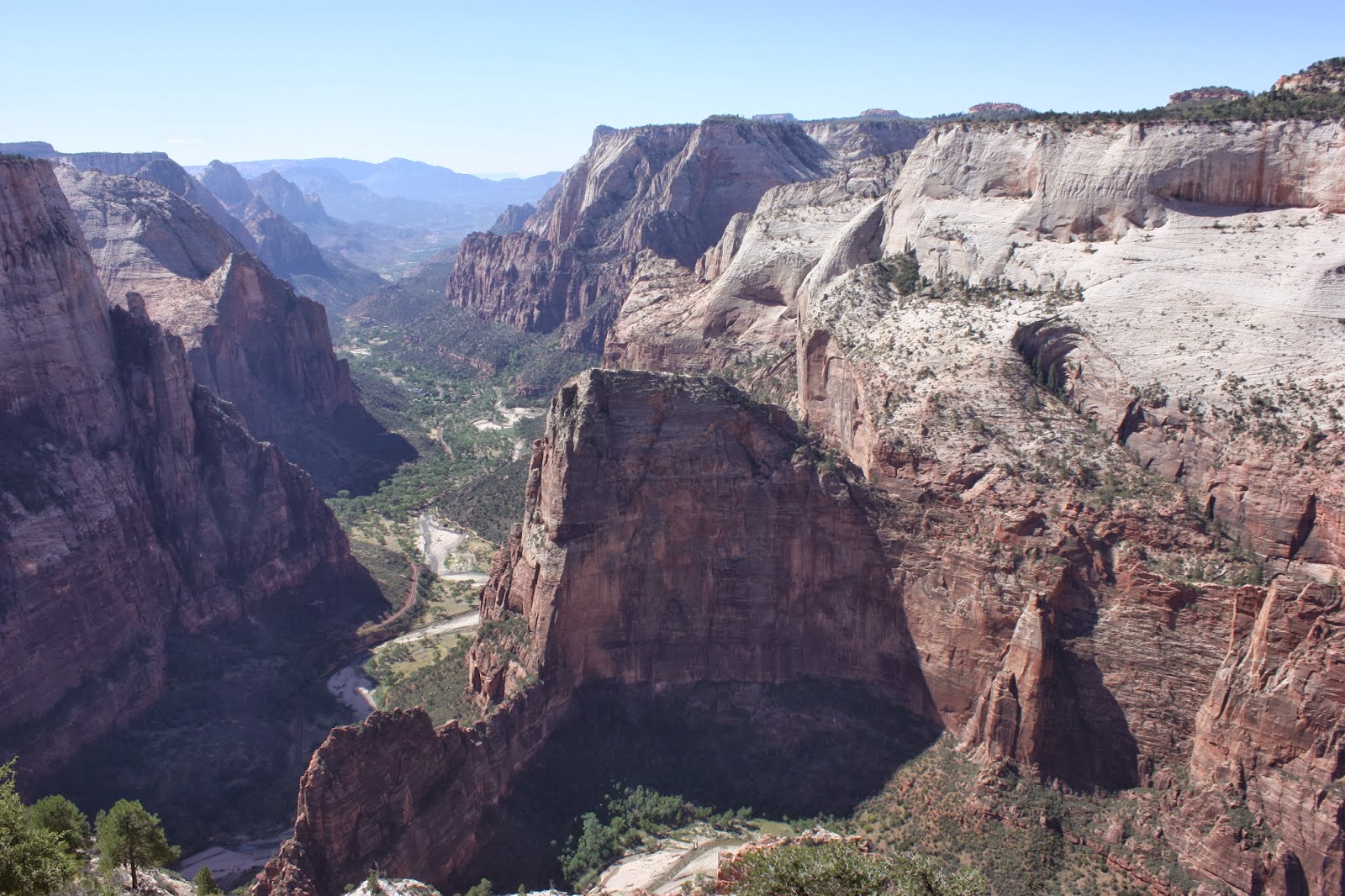
The payoff proves to be well worth the long, uphill trudge. 
Note: The large, fin-like rock formation in the center is Angels Landing.


I rested under the shade of a juniper tree not far from the rim while enjoying my lunch and rehydrating. It was a warm, sunny late September day. I remember thinking how hot it would have been to try this hike two months ago.
I enjoyed the views until I finally made myself turn myself away and start retracing my steps, trying to enjoy the details of my descent.
As I neared the trailhead, I stopped at the trail junction to Hidden Canyon and decided to go check it out. It proved to be a worthwhile and scenic side trip, and one that I'd recommend to anyone who enjoys canyon exploring. Keep in mind, there is some exposure to drop-offs while rising into this canyon.

It was an awesome day of exploring some parts of Zion that I had always wanted to check out. It only took me over 20 years of living in Southern Utah to do it. That's not bad, right?

Tuesday, December 31, 2013

Happy New Year!

Happy New Year! I am beyond appreciative for those of you who tune in to my blog. I hope all of you have a 2014 full of new, unforgettable experiences. May your ambition lead you to places above and beyond your wildest imagination. May you love others, love the earth, and experience the fullest offerings that life has to offer. 

2013 was by far my best year yet for outdoor adventures. It included multi-night backpacking trips to the Grand Canyon, Mount Rainier, and the High Uintas of Utah, not to mention numerous other camping trips and day hikes. Unfortunately, I have yet to post about any of these adventures! That leads me to my New Year's resolution:

To get caught up on this blog! I continue to slowly chip away, but I am still a ways from being able to post about my most recent adventures. I fully plan on being caught up by the time 2014 ends. It will be a challenge, but one that I'm excited to take on. 

So long, 2013! You were a great year, but something tells me 2014 will be even better. There is always an excitement of the unknown that I feel at the end of each year. I have no idea exactly what 2014 will bring, but just thinking about the possibilities already have me wanting to fast-forward. 

Best wishes for the new year,

Mike

Friday, December 13, 2013

Angels Landing

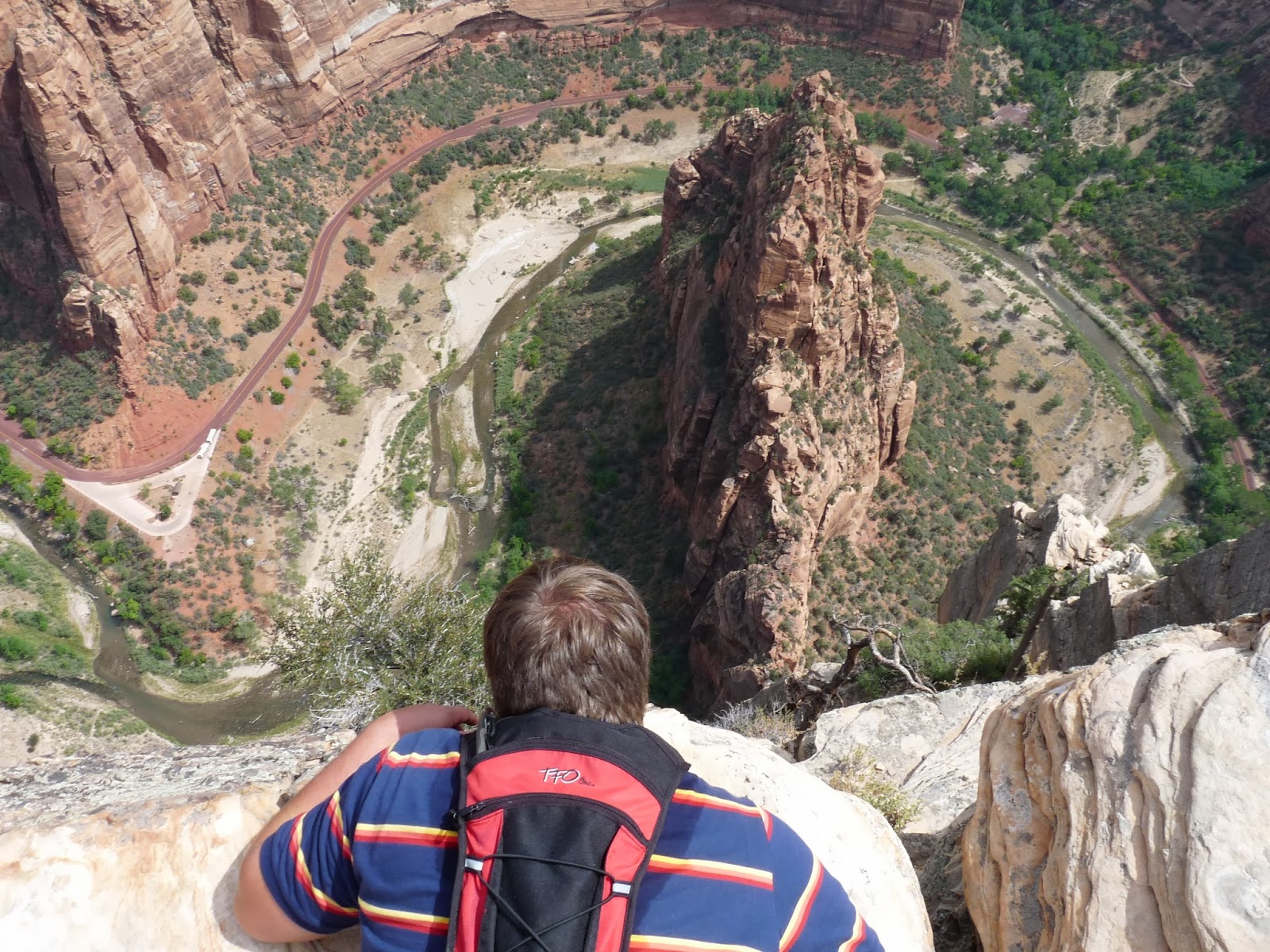
By far the most famous Zion hike is Angel's Landing. The trail is 5 miles round trip with 1500 feet of elevation gain. While these stats aren't overly daunting, the trail isn't for the faint of heart. The first 2 miles climb steadily with many switchbacks, but the "hard part" is the last half-mile. After an area called Scout Overlook, the trail skirts across the spine of a huge rock slab, with drop-offs on both sides up to 1500 feet, before eventually dead-ending at an overlook with incredible views in every direction.
Chains have been installed intermittently across the "dangerous parts" by the National Park Service to give you something to hold onto. The trail is extremely popular and the most difficult part is safely avoiding hikers traveling the opposite direction. In most areas, this isn't too difficult, but there are narrow sections of the trail that can be tricky during high volume foot traffic.
 
Unfortunately, every now and then, there are fatalities on Angel's Landing. That fact alone discourages some people from attempting it. Although the hazards shouldn't be taken lightly, the trail is not overly difficult for a reasonably fit person that doesn't have an extreme fear of heights. I always just assume everyone else on the trail is an idiot, and I play it as safely as possible on the narrow sections. It's a great hike that I've done 3 times now, and I'd probably bet on myself going back some day.

Here are some highlights from my trips.

From my first trip, in August 2009 with friends Dustin and Ali:

(Yes, the trail goes over that, and it's not as bad as it looks.)
 
Dustin and Ali, making their way towards the top with a 1,000+ foot drop-off below:

Hanging out at the top: 
(On a side note, what was I thinking when I bought those sunglasses?)

Dustin, looking straight off the edge (much more daring than I am):
Spectacular views:
My last trip to Angel's Landing was with my girlfriend, Stephany. Here are some photos from that March, 2011 trip.

Just starting off, and looking up at what's ahead of us:
Looking up at the switchbacks before Scout Lookout. This series of 21 switchbacks is famously known as Walter's Wiggles.

 At Scout Lookout, the turnaround point for many: 

 (But not us.)
 
If you time it right during early spring, you might get some snowcapped views.
 
You just can't beat this:
The views alone are tough to match, and if you're looking for a bit of a thrill, you'll probably enjoy Angel's Landing. Just don't let anyone talk you out of it!

Wednesday, December 11, 2013

Zion Introduction

Zion National Park is one of the most impressive and recognizable places in the world. A first timer's drive through Zion Canyon might results in some serious neck cramps from admiring the enormity of the towering rock formations that draw almost 3 million visitors to the Park every year. Like many national parks, Zion offers a wide variety of recreational opportunities, including hiking, rock climbing, canyoneering, and the casual "sight seeing." You don't have to get too far into the backcountry to be impressed by Zion's geologic features.

About 13 million years ago, the Virgin River began to cut into the rising Markagunt Plateau. This marked the early stages of the formation of Zion Canyon. Today, Zion Canyon continues to get sculpted and carved by the Virgin River. The main forces behind this are flash flood events; common occurrences in the desert where rain is infrequent, but it can be torrential.

As a kid growing up in St. George, Utah, by far the closest National Park was Zion. Whenever my family had visitors, we would always take them into the Park. We'd usually spend about half a day in the Park, sightseeing and maybe doing a short hike or two. One hike, Weeping Rock, was usually our family's "go to." It leads to an overhanging arch with year-round water trickling through it and raining down below. It's a scenic hike, and refreshing in the heat of the summer (although you're not going to get much of a workout from it.) I've lost count of how many times I've hiked that trail over the years. More than 20, or at least that's how it seems.

All the way through high school, I continued making frequent trips to Zion, sometimes with friends, sometimes with family. However, most of these trips consisted of short, easy hikes. Scenic, but not overly memorable. It wasn't until I was in my early 20's that I finally did any "serious" hiking in Zion.

Over the past few years, I feel like I have been able to appreciate my Zion visits much more than I did when I was a kid. Having lived less than an hour's drive from the Park, I think I was somewhat oblivious to the unique beauty of Zion. Now, having seen many other national parks and returning to Zion, I see that it really is on par with some of the most amazing places in the country. No national park is quite like any other national park.

I'm still by no means a Zion expert, and I'm embarrassed to say that I've yet explore some of the Park's best terrain. One day I hope to expand my knowledge of Zion, and explore more of the Park's remote backcountry. Fortunately, I have checked out some of Zion's most scenic and popular areas. Most of the time, there's good reason for popularity (an adjective I try to avoid when hiking, but sometimes the appeal to too large.)

I hope you enjoy my Zion adventures. I'm sure these places will be familiar to some of you. For others, hopefully you'll see what kind of adventure and beauty Zion has to offer.

Tuesday, December 3, 2013

A Summer of Salmon

Many years before I became an avid hiker, my favorite outdoor activity was fishing. Growing up in Southern Utah, I have fond memories of my dad taking me fishing for bass and trout. When I was in high school, sports and other activities kept me preoccupied and my interest in fishing slowly fizzled out. However, in my late teens and early 20's, something revived my fishing enjoyment. My renewed interest led to me to spending many days and countless hours fishing for bass and trout in Southern Utah. I made an effort to research some of the best methods to catch fish and it paid off. The more fish I caught, the more addicted I was to fishing. Nothing could beat the adrenaline rush of feeling a tug on the end of my line and the anticipation of what might be hooked at the other end.

My passion for fishing remained until I left for Washington in 2010. It was during this summer that I became an avid hiker and backpacker, and fishing became less of a priority. I still enjoyed fishing, but more and more I found myself wanting to get out and explore and put some mileage on my boots, rather than dedicating a road trip to standing by a lake or river.

Then, I accepted a job in Alaska.

Early in the summer, fishing wasn't really on my radar. I was more excited to bag peaks and explore than to search for fish. Then, a couple of weeks after I arrived, I got a new roommate named Brett. It was Brett's second summer in Juneau and first since 2008, and he made it clear from the first day he moved in that the local fishing was pretty spectacular. This immediately sparked my interest and I knew I'd have to fit some fishing trips in on my days off, around the obvious hiking trips.

After buying a cheap rod/reel combo at the local Fred Meyer along with a few lures, I was anxious to hit the water and see what I might be able to reel in.

Most of my fishing time was spent at Auke Bay, which was the closest and most convenient place to Forest Service housing. We'd usually take the public bus to DeHart's, the local convenience store located right on Auke Bay. DeHart's had everything we needed to load up on supplies, and conveniently had two separate entrances: one for alcohol and fishing stuff, and the other for everything else. We usually didn't bother with the "everything else" section.


My first couple of fishing trips were pretty uneventful and I didn't catch anything. I quickly learned that even Alaska fishing can be a test of patience. It was pretty frustrating one day watching several other people reel in some big king salmon while I didn't catch a thing. Luckily, my persistence would eventually pay off.
There are five different types of salmon that come into the ocean shallows of Southeast Alaska before making their up streams and rivers to spawn. The early season spawners are the sockeye, king, and pink salmon (pinks are the most abundant and will continue spawning through the majority of the summer.)

My first successful fishing outing came in early July. This pink salmon was my first fish of the summer, and first salmon ever!
After that, things slowed down and not much was caught between me and my friends. We stuck with it though, and waited for the tide to start coming in. Along with it, so did the fish. We started to see some big salmon cruising the shoreline, no more than a few feet out. We'd usually add some length to our casts by wading into the water up to our knees too (surprisingly, the water wasn't very cold in Auke Bay). Suddenly, I felt a strong tug on my line and knew I had something big. I fought the fish to the shore, and several times it made runs, taking my drag before Brett could snag it with our net. I was worried that my cheap reel wouldn't hold up. Kings have a reputation of not being the best fighters, but this one wasn't coming in without some serious resistance. As I reeled, my reel gears felt and sounded as if they were cracking! Finally, I got the fish close enough to shore that Brett was able to scoop it into the net. I was happy with what we pulled out of the water. A nice king salmon! About 32 inches and fat.

Back home I normally catch and release, but I spent the extra money for a king salmon stamp when I bought my license and the temptation of cooking fresh salmon was too much. I kept it, along with pink I had caught earlier.

A size comparison between my pink and king salmon (my foot is a size 13, in case you were wondering.)
The next day, filleted the salmon and marinated it in a delicious concoction of soy sauce, brown sugar, lemon, and spices. That night, I took the salmon over to my friend Tim's house, and cooked it on his propane grill. It turned out pretty amazing, probably even better than I could have hoped for. There are few things more satisfying than catching your own fish, filleting it, and preparing/cooking it yourself. There was plenty to be shared with Tim and his roommates, and I was happy to offer it up. It was one of my most memorable experiences from Juneau.

As the summer went on, I continued fishing but it was hard to top the experience of catching my first king salmon. Soon, most of the kings and sockeye had spawned and most of the fish in Auke Bay were pinks (still fun to catch, but not nearly as delicious as most other salmon.) One day, I had a hard time not accidentally snagging a pink on almost every cast. It always made for a tougher fight but there became a point where that wasn't very fun.

Here's one of the many pink salmon that I reeled in over the course of the summer. This one is a male (which only get the hump after they come into the shallows and get ready to spawn.) That's why pink salmon are sometimes referred to as "humpies"
One day late in the summer I woke up early to go fishing with my roommate, Brett before work. For some reason, he had the hot hand that morning, and he caught several chum (AKA dog) salmon while I was completely skunked. Here's a look at one of them while he reeled it in.
The unique striping made these salmon unique from the other species. They were also known to be one of the worst salmon to eat, and were usually caught and released. The only one I caught all summer was an accidental snagging (which doesn't really count, in my book.)

I've yet to figure out what kind of fish this one was (it was quite a bit smaller than any of the salmon I caught) but it had a really weird wound, as if a predator took a chunk out of it. My guess is it was either from a seal or another fish.

One day, my roommate Brett and I got the genius idea of going out to Lena Point (north of our usual spot at Auke Bay) during low tide, casting out some bait as far as we could in hopes of maybe luring a halibut or some other type of large, deep sea fish to bite. Halibut are usually caught from boat, but the water at Lena seemed to drop off pretty deep right away, so it seemed reasonable that we could be in the depths of where halibut hang out. We cast out our salmon setup and set the rod down while rigging up another rod for salmon fishing. We checked on the rod periodically, and at one point Brett got my attention and pointed to the rod. Sure enough, the rod tip was bouncing around as if there was something hooked. I ran to the rod and started reeling in. Unfortunately, whatever was making the rod move seemed to have gotten away, and I just reeled my way into a snag. To this day, I wonder what was jerking the rod.

Later, we reeled in this sunflower seastar:


 Of course, it ended up back in the water, unharmed.

A while later, I got a phone call from my girlfriend. I decided I could use a break from fishing so I took her call and found a spot to sit down just up from the shore. About five minutes into my conversation, Brett got my attention and pointed into the water. My backpack was floating several feet out from shore! Although my backpack had been safe just a few minutes earlier, I had underestimated how fast the tide was moving in. I got off the phone and retrieved my backpack, and suddenly, a sense of panic set in. My backpack was unzipped, and among other things, my digital SLR camera had been inside (although not anymore.) I searched around the shore to no avail, and yelled out loud with frustration. Meanwhile, the tide was still coming in, and Brett was doing his best to help by hopping into the water and retrieving some of the fishing lures that fell out of my backpack. As he stood waist deep, he reached down, and one at a time retrieved several lures. I was happy for his efforts, but still...no sign of my camera.

I was super bummed out, but it could have been worse. My work keys were also in an unzipped compartment of my backpack, but somehow they didn't fall out. Phew!

After the tide had moved in far enough that there was no longer any hope of retrieving any other items, I sat there in disbelief for a few minutes before we decided to leave. I think Brett would have stayed longer, but he knew at that point I simply wasn't in the mood.

I had to work the next day, but Brett had the day off and offered to head back out to Lena Point to search for my camera. I had already come to terms with the fact that the camera was probably ruined (I hear that water isn't good for expensive cameras, let alone salty ocean water), but I was more interested in salvaging the memory card. We had just hiked to Mt. Jumbo a few days earlier and I had hadn't saved the pictures yet. During my lunch break I texted Brett and asked if he had any luck in finding the camera. His response: "It was dangling from a barnacle, above the abyss."

If you've read my Mt. Jumbo entry, you already know that the pictures were salvaged from the memory card. The camera? Not so much, but I already expected that.

The last of the five species of salmon to spawn in Southeast Alaska are the coho (AKA silver) salmon, and many people argue that coho provide the best fishing of all.

The coho were the only salmon species that eluded my roommate, Brett, during his previous summer in Juneau. His determination to catch a silver this time around rubbed off on me, and we spent multiple fishing trips in search of the silvers. Time and time again, though, we were eluded.

One day I got home from work, and Brett (who had just gotten home from fishing) was outwardly disappointed. When I asked how it went, he looked at me and shook his head. I asked "Let me guess, you had a silver hooked, and it got loose?", to which he replied "Mike, it's so much worse."
This is Brett's story, as I remember it:

He was fishing at Lena Point that day, and he saw a silver jump out of the water. He casted towards the splash and he immediately had a fish on. The fish was a great fighter and it took him a while to get it close to shore. Finally, the fish came into view: it was a silver! However, the shoreline was rocky and it was an awkward spot to hoist it out of the water. The fish wrapped itself around a rock where it broke his line, but the fish continued to lay there, stunned from the fight. Brett jumped into the water, grabbing the bit of line that was still attached to the fish and wrapped it around his wrist. As he tried to pull it out of the water, the line broke again. At that point, he tried hoisting the fish out in an underhand motion, but he was unable to push the fish to shore. Just then, the fish swam away. It was gone. Brett was beside himself. He glanced behind him to see some people that had observed the whole debacle, where he made eye contact and let out a booming scream. His first silver had literally slipped in and out of his hands.

Brett's story only added to my determination to catch a silver. A couple of weeks later, Brett finally caught his. He was so happy with the fish he couldn't bring himself to bring it home and eat it. He released the fish and his summer felt complete.

By then, the summer was winding down. Brett's season was over and he had left Juneau a few days prior. I still had a couple of more weeks remaining, and my dad came up for a visit from Utah.

Of course, I had to take him fishing.

We started where Brett had caught his silver about a week before at Montana Creek. After a couple of hours with only a small dolly varden that I inadvertently snagged by the tail to show for our time, I decided it would be wise to try somewhere else.

My dad had a rental car, and it was a good opportunity to go check out a place that I didn't have access to on the public bus. The area that encompasses the 45-miles stretch of road north of town that eventually dead-ends (referred to by locals as simply "out the road") had some great fishing and hiking spots. Unfortunately, the public bus didn't go that way. During a few occasions that summer, I was able to creatively find ways "out the road", but for the most part I was limited to the areas between the Mendenhall Glacier and downtown Juneau.

Located about 38.5 miles "out the road" is Cowee Creek, a place that I heard has good silver fishing. I had been there a few weeks before, only to find nasty pink salmon nearing the end of their spawn. Surely by now (mid-September) the silver spawn would be in full force. 
We parked by the Cowee Creek bridge and hiked along the Cowee Creek Trail. The creek was pretty overgrown so access points were limited. We tried to make the most of the few good spots we found.

The last time I was in the area, I saw a small black bear. Obviously, there were still bears around.


I had also heard of brown bear sightings in that area in years past, although for the most part, brown bears are uncommon around Juneau.

We found some good fishing spots and about half an hour into our trip, I felt a strong tug on my line. It had to have been something big. I fought it for a couple of minutes before getting it to shore where it appeared: a nice silver! Unfortunately, I was in a pretty awkward spot to land a fish. I got the fish close to shore, where my dad helped to hoist the fish out of the water. Then, I'm not exactly what happened, but it was nothing good. the fish got wrapped up in a log and snapped the line. Off it swam, lure and all. I yelled out with frustration and I remembered Brett's similar encounter when his silver got loose. I couldn't believe it. My dad obviously felt bad for me, but I didn't feel bad for myself. I just wanted to catch another.

Later, we made our way back towards the road as the creek became progressively trickier to access the further we hiked. After I lost the fish, my frustrations were made even worse by losing a couple of lures on bad casts. Now I was on my last pink Mepps spinner (which seemed to be the lure of choice.)

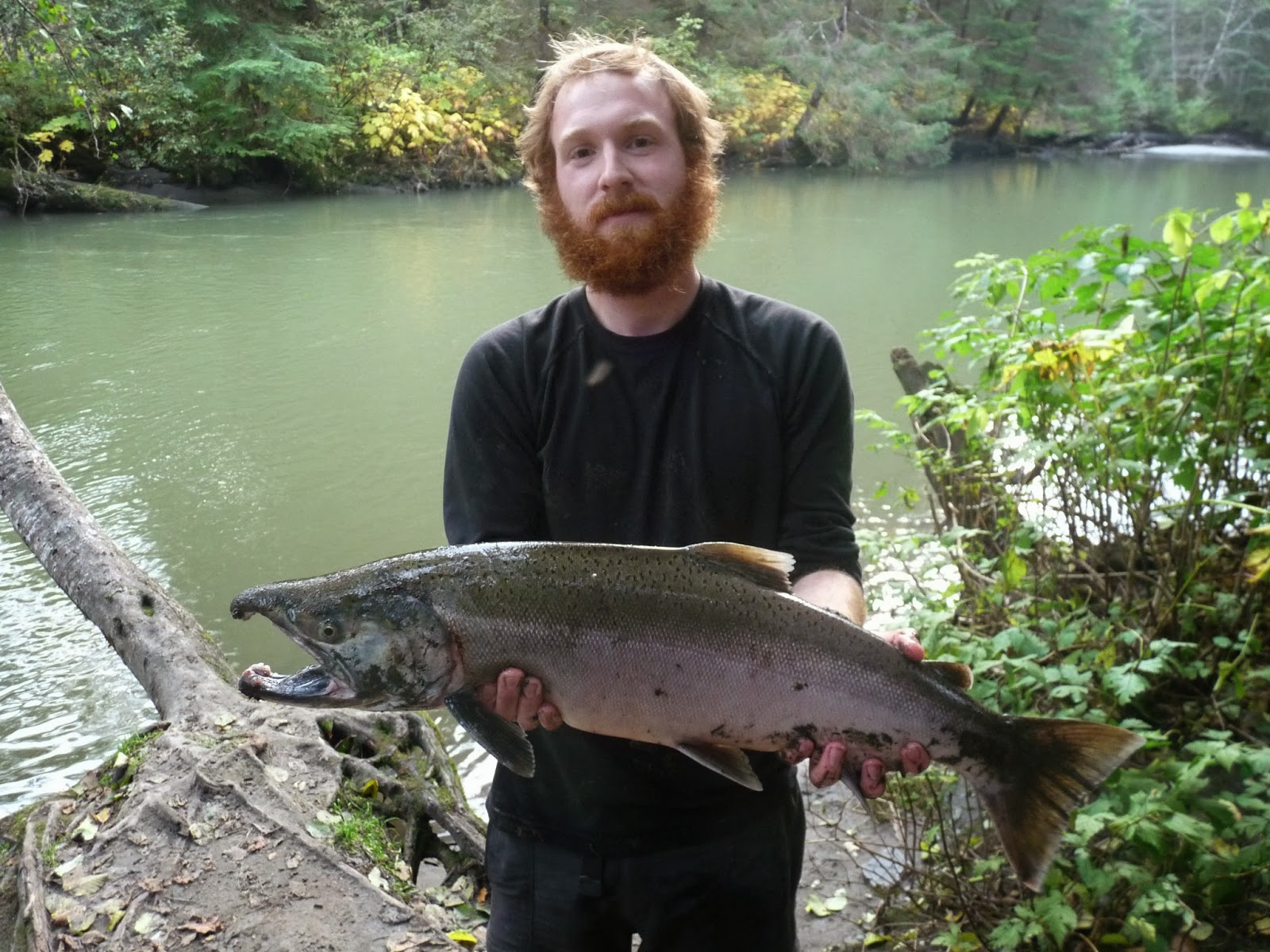
I was now casting into a wider, more open stretch of the creek. A few casts in, another fish hit my lure hard. It felt jut like the first, but his time, I was ready. This time, I had room to backpedal when the fish neared the bank. I had room to pull the fish a couple of feet out of the water, but even then, I was worried it would get loose. The embankment was sloped, and for a second the fish began to slide back towards the creek! Luckily, my dad was there to scoop it up and toss it up to level ground. Finally! And sure enough, it was a nice silver.


(Also, notice how well my beard had progressed from the beginning of the summer.)

The fish was about 28 inches long. A beauty, at least to me.

We were fairly rough with the handling of the fish, so I decided to take it home for dinner the following night. As for my dad, he didn't end up catching anything, but I give him just as much credit for that fish. I'm not sure I would have landed it without his help.

Unfortunately, my dad had to leave the next morning so he missed out on the consumption of the fish. At least I was still able to share it with some friends. It turned out every bit as delicious as the king salmon I caught earlier in the summer. Silvers are a little more lean than kings, but I found them to be equally tasty.

My summer would be ending soon. At that point, I was completely content with my summer accomplishments. I went on some awesome adventures, I caught and prepared some delicious fish, and I made some lifelong friends. What more can you ask for during a summer in Alaska? Well, there is a lot more, and I barely scratched the surfaces of all of Alaska's offerings. I have a feeling that one day I'll be back, experiencing more of Alaska, and making more friends. Even if I do, the summer of 2011 will be a tough one to beat.