Thursday, March 28, 2013

John Muir Cabin

Since the first day I arrived in Juneau in April, I was excited for my late-June visit from Stephany (my girlfriend). There was plenty to be done around Juneau when she arrived without significant planning in advance, but I decided to look into reserving a backcountry cabin a few weeks prior.

The Juneau area has several rustic cabins available for overnight use by the public, which require a fee and reservation on www.recreation.gov. Some of these cabins are easier to access than others, but all of them are hike-in. A few weeks before Stephany arrived, I got online and searched for the availability of these cabins during the time that she'd be in Juneau. I found that the cabins are usually booked weeks (or sometimes, months) in advance, but I was able to reserve the John Muir Cabin for one night during mid-week.
The John Muir Cabin is accessed from the Spaulding Meadows Trailhead along the Glacier Highway, just west of Auke Bay. This trail forks after .8 miles, where you take a left on the Auke Nu Trail, which eventually ends at the John Muir Cabin.

Me and Stephany, at the Auke Nu Trail junction:
After reaching the Auke Nu Trail, the landscape began to change from evergreen forest to muskeg (boggy, open areas with patches of stunted trees).

Most of it looked something like this:

Stephany:
Several of the trails that I hiked in Alaska were built with boards, especially in areas of muskeg. The wooden platforms kept your feet out of the mud, but they were also very slippery when wet. Almost everyone that I hiked with ate some dirt (or wood) at some point during the summer. Ouch!
 
The trail steadily ascended through muskeg, and soon, we knew we were nearing the cabin. Each time the trail disappeared over a hill in front of us, we thought for sure the cabin was just out of view, until we reached the top to find the trail continuing with no cabin in sight. It wasn't a steep or overly grueling trail, but 1500 feet of elevation gain in 3.5 miles was enough for a workout.
 
Finally, the cabin came into view - a welcome sight:
We're there! 
The views from the porch were really nice, and you could see into Auke Bay and the Gastineau Channel.
Another view, looking the direction of the trail:
The cabin itself was pretty cool, too. It was built in 1980 to commemorate the 100th anniversary of John Muir exploring Southeast Alaska. I think it has been renovated in recent years because it looked very nice and new, both inside and out.
 
A look inside the cabin:
I wasn't expecting the spaciousness. The staircase led to an attic with more space for people to sleep, if necessary (there were also two bunks downstairs).
 
After setting our stuff down and having a look around the cabin, we went back outside to catch a glimpse of the sunset.
A gorgeous evening.
 
That night, we played cards with a deck we found in the cabin. We also made our own Boggle board in the cabin "sign in" notebook. Stephany is a Boggle master, but sometimes I beat her, even though she'll never admit it!
To this day, I wonder if anyone else staying there played Boggle with our board.
 
The next day, we had more plans, so we didn't stick around too long after waking up. We stopped to enjoy the views one more time before saying farewell to the cabin.


 I was happy to show Stephany an awesome place while she was visiting, and there was still more to come. As long as you have the time, there should always be more adventure to come when you're in Alaska. It's a state that's best experienced by getting outside. Isn't that the point?

Sunday, March 24, 2013

Mount Roberts

During my summer in Juneau, by the time June had rolled around, I was anxious to start hiking up some of the nearby mountains. Up until this point, I had taken advantage of the lower elevation areas (such as Herbert Glacier). There came a point, though, that the higher country couldn't be neglected any longer, even if I did have to deal with some snow.

The Thunder Mountain trail was my first attempt at reaching the higher country. I made it about two-thirds of the way to the top of the mountain before running into snow that was deep enough to force me into turning around. This is one I'd have to give another shot later in the summer.

During one of my next days off, I decided to attempt another mountain hike: Mount Roberts. Roberts is accessed near the downtown area and actually has a tram that can take you 1800 feet up the mountain, where there is a restaurant, gift shop, and nature center. However, it doesn't take you very close to Roberts' actual summit, which tops out at over 3800 feet. I was pretty sure it would still be too snowy to make it all the way up, but there was only one way to find out!

My roommate, Brett, who worked on the ferry (and had the lucky schedule of one week on, followed by one week off), and another friend, Lauren, accompanied me on this hike. They were both good hikers, and I knew that no one would be slowing anyone else down. We took the public bus to the downtown area before hopping on the trail and starting our ascent of Mount Roberts.
(Notice the tram line on the map)
 
When we hiked to the top of the tramway without running unto snow. This seemed like a good place for a break. It was a warm, humid day (by Juneau's standards) and we caught our breath while checking out some of the exhibits and the captive bald eagle that was on display. Even though we were in no real hurry (by June, the daylight hours were really long), our break was brief and we continued up the trail towards the summit of Roberts.
 
Soon after the tram, the trail took us above tree line and rose into subalpine meadows. For the first time, views of the Gastineau Channel appeared and I got the sense that we had left the "touristy" part of Juneau, and entered a wilder realm.
 

We steadily ascended contours, and soon, we began to run into snow. At first, it was patchy and nothing to keep us from advancing. However, once we reached Gold Ridge (see map), it was apparent that our route ahead would require some serious snow traversing. This would mark our turnaround point. At this point, I also realized that I hadn't taken any pictures yet that day! Out came the camera.


On our way back down, we were all really hungry, so we decided to stop at the restaurant at the top of the tramway for dinner. I enjoyed a delicious burger and beer. I savored every bite and sip. Nothing is better after a long hike than a burger and beer (except for maybe pizza and beer.)
 
After dinner, we still had a couple of miles to get back to the trailhead, and none of felt up to it with greasy food now weighing us down. Luckily, they let us take a free ride down on the tramway when showing our dinner receipts. It was a lazy way to finish (and sort of cheating), but who would turn down a free ride? Plus, I think it was deserved after almost 3000 feet of elevation gained.
 
We were back at sea-level within minutes. Eventually, we'd have to catch the bus back to where we lived, but not before maximizing our time downtown by enjoying a few more drinks at the Alaskan Bar.
 
It was an awesome day, and the company was thoroughly enjoyed. I have learned from all of my adventures that nothing beats a three-person hiking team for company.
 
The summer had really just begun, and I still had some of my most memorable exploits to look forward to.

Wednesday, March 13, 2013

Herbert Glacier

In the outdoor world, Alaska is probably best known for its astounding high country. I did plenty of hiking in the mountains during my summer in Juneau. However, when I first arrived in late April, deep snow was still clinging to the high country. Those mountain hikes could wait until later in the summer when trudging through snow wouldn't be required.

Luckily, the Juneau area is situated barely above sea level. The nearby Pacific Ocean, combined with its position in far Southeastern Alaska make the climate much milder than most of the state. Juneau is considered to be a temperate rainforest and gets precipitation year round (including quite a bit of snow in the winter), but by the time I arrived, the lower country was entirely snow free. This made it a good time to explore these areas while waiting for the mountain snow to melt.

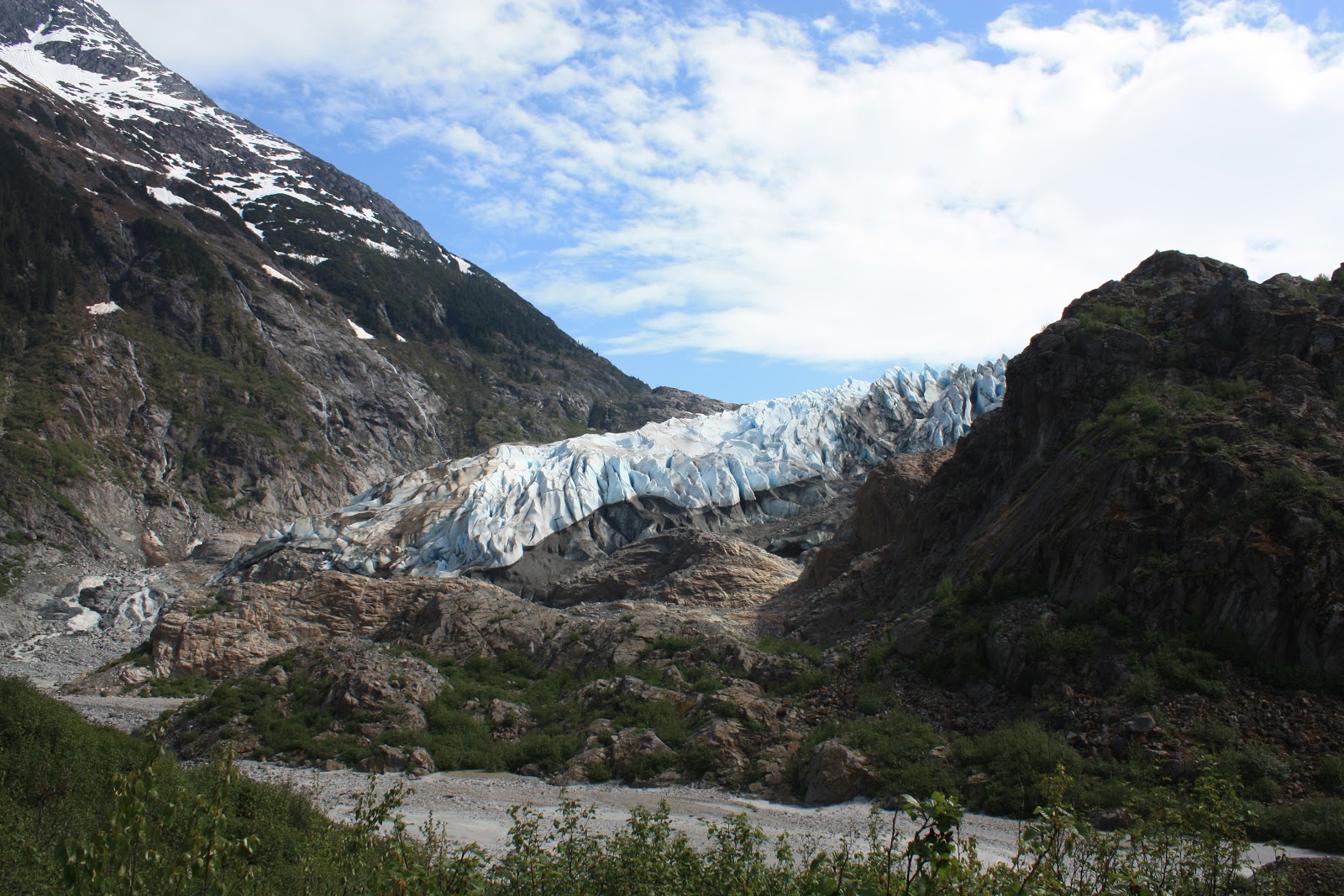
The Herbert Glacier is fed from the Juneau Icefield - a massive area of ice larger than the state of Rhode Island! Of the 38 glaciers that the icefield feeds, is it probably the second most easily accessed (after the Mendenhall, where I worked).
The Herbert Glacier Trail is accessed between mile markers 26 and 27 on the Glacier Highway, which runs northwest from Auke Bay. This section of highway is commonly referred to as "out the road" by Juneauites.
 
I ventured out with a couple of roommates/co-workers who also had the day off. The hike started on a flat, well-maintained trail that meandered through old growth forest. Like most glaciers in Alaska, the Herbert is receding. As we got closer to the glacier, the vegetation began to change, and newer growth became more prominent. This was revealing an area that was ice-covered much more recently than where the trail started.
 
After about 5 miles, the trail led us to the Herbert River, with our first view of the glacier beyond.
This was basically the end of the trail, but we kept going, trying to get as close the glacier as we could. After making a couple of shallow river crossings, a very deep, roaring section was a major barrier between us and the glacier. We were still close enough to get some impressive glacier views, though.
We hiked up a side drainage which required a bit of hand-over-hand scrambling. It was well worth our efforts and offered a different perspective of the glacier:
The terminus of the glacier appeared almost liquid...as if you could mold it into shape. I could barely wrap my head around such a spectacle!
Unnamed peak near Herbert Glacier:
After a lunch break, we turned around and headed back down the trail, the way we came, again noticing the vegetation changes in reverse order.
As we reached the trailhead, I noticed that despite the 10+ miles we logged, I barely drank any water. I had taken no more than a few sips from one of my Nalgene bottles, and the other I hadn't even touched. It was an easy 10 miles with minimal elevation change. Still, I was used to the desert of Southern Utah where feeling thirsty is pretty much "the norm," regardless of what you're doing. I remember thinking I could get used to the damp Southeast Alaska air.
 
It was great intruductory hike to the Juneau area before tackling some of the mountains, and one that I'd recommend to anyone.

Sunday, March 10, 2013

Juneau, Alaska Overview

Prior to the summer of 2011, I applied for jobs all over the country, mainly with the National Park Service and U.S. Forest Service. It was anyone's guess where I would end up. One day I got a phone call asking about my interest and availability regarding a Forest Service position in Juneau, Alaska. I didn't know much about Juneau, other than a couple of basic facts: 1. It's the capital of Alaska. 2. It isn't connected to any road systems outside of the town. I also knew that Alaska was a state unlike any other. Its size, beauty, and remoteness made it a place that I had always wanted to explore some day. To say that Alaska's outdoor opportunities are endless is in no way an exaggeration. It wasn't exactly on my radar for that summer until I received the phone call, but it got me thinking: Why not this summer?


I interviewed over the phone for the interpretive Park Ranger position, and got an offer shortly after. The opportunity to work and live in Alaska for a summer would normally be a no-brainier, but my decision was made tougher since I had recently started dating my girlfriend, Stephany. I knew it wouldn't be easy to do a long distance relationship for the summer. After weighing my other options and talking with Steph, she was supportive, and I made the decision to accept the job.

I would be working out of the Mendenhall Glacier Visitor Center in the Tongass National Forest: the largest national forest in the country. My job involved presenting interpretive programs to the public on a variety of topics: black bears, salmon, arctic terns (a type of bird with the longest migration on earth - Antarctica to Alaska), glacier dynamics, and glacial ice, just to name a few.

The job was a good experience, and in the process, I met some interesting people from around the world. Many of my co-workers became good friends, and I got to do it all while working in a gorgeous area.

However, that was still work. Luckily, there were still two days a week that I had to myself to go do as much exploring as possible.

Besides being away from Stephany, the toughest part about the summer was transportation. I left my car at home due to the high price of shipping it on a ferry. Most of my friends were also without vehicles for the summer, so "getting around" involved riding my bike or taking the public bus. Sometimes it wasn't ideal, and sometimes I didn't get to go exactly where I wanted, when I wanted to, but I was still able to go do my thing easily enough.

Although there was plenty to do, I never made it outside of the Juneau area. In reality, even after a full summer of hiking and fishing every chance I got, I barely scratched the surface of all there is to see in Southeast Alaska, let alone the entire state.

Don't believe me? Here's Alaska superimposed on the contiguous 48 states:


In case you need any interpreting: if you consider the Aleutian Islands, Alaska covers an area from California to Florida, and north to the Canadian border. It's that big.

I hope you enjoy my following posts on the Juneau area. It was a great place, and I hope to make it back to Alaska some day for further exploration and adventures!


View of Mendenhall Glacier with Mount McGinnis and Mount Stroller White from Nugget Falls Trail, near the Mendenhall Glacier Visitor Center.

Wednesday, February 27, 2013

Olympic National Park

As spectacular as Mount Rainier is, there are other amazing sites to see in Washington. Among these are two other national parks: Olympic and North Cascades (Rainier is actually the smallest of the three.) During my days off, I usually stayed in the park for my exploring, and there was plenty to be done. However, when I was able to get a few consecutive days off, it was tough to pass up on an opportunity to go check out a different area. My friends, Dana and Kenton, had the same time off work, so it was a good opportunity for the three of us to go explore a new place.
Between the three of us, we chose Olympic National Park as our destination. Olympic is the largest and most diverse of the three national parks in Washington, encompassing over 922,000 acres on the Olympic Peninsula.

Due to its large diversity, Olympic is often referred to as "Three Parks in One." The coastal region of Olympic is separated from the main body of the Park, and consists of beaches, tidal pools, and sea stacks (jagged rock outcroppings that jut straight up from the beach.) The western part of Olympic's main body is mainly comprised of temperate rainforests, with massive Douglas fir, sitka spruce, and western red cedar trees. Further east, the Park is much drier due to the rainshadow effect. Hurricane Ridge lies the Park's northeast corner. This is one of the most easily accessed and most visited areas of the Park. Here, you get an entirely different take on Olympic with excellent views of the Olympic Mountains, and abundant subalpine meadows.

On our trip, we started at the coastal district. We spent a night at the Mora Campground before exploring nearby Rialto Beach the following day.
There are no trails at the beach, and simply wandering the shore was the name of the game. The unique geology and tidal pools made it one of the most spectacular beaches I've ever seen.


Me, Dana, and Kenton on the beach:


We wandered the beach for a few hours, admiring the awesome beauty. It was a tough place to leave, but we knew there were other areas of Olympic that were equally impressive. When we finally got our fill, we hit the road and headed to the Hoh Rainforest on the main Park district's west side.

The first time I arrived at Rainier that summer, the first thing that caught my attention was the massive trees. I grew up in Southern Utah, where even our biggest trees are dwarfed by the average tree in the Pacific Northwest.

At Olympic, some of the trees even put Rainier's trees to shame.

Here's an example. This sitka spruce is about 270 feet tall, over 12 feet in diamater, and estimated to be over 500 years old:


On our way to the Hoh River trail for some more forest exploring, this herd of elk was grazing not far from the road:
We arrived at the Hoh River Trail, and quickly got started with our hike.
The trail leads to the base of Mount Olympus after about 18 miles, but we would be turning around long before then. We didn't come equipped with backpacking gear, and we still needed to find a campsite that night.
 
The trail winds through the lush Hoh Rainforest, which gets between 140 and 167 inches of precipitation each year. Massive trees draped with moss and lychen crowded the trail, and every step along the way provided its own unique perspective. Rarely have I ever seen a place so alive!


The afternoon shadows made certain areas of the forest especially cool, almost in an eerie way.
Some of the giant trees' root systems were growing high out of the ground. Everywhere I looked, I was at awe with the unique features of this amazing forest.

Near our turnaround point, there were two huge western red cedar trees, right next to each other. I had one of my friends snap a shot of me sitting between the two.
That night, we found a secluded campground in the Olympic National Forest. We still had two more days to explore, and I couldn't wait.
 
The next day, we headed to the Sol Duc Hot Springs on the northwest side of Olympic. The hot springs themselves were run by a private company, and it seemed to be somewhat touristy and not quite what we expected. Luckily, there was a trailhead nearby and we decided to see where it would lead us.
Although I don't recall the exact trail we took or how long it was, it looks like there are a couple of options you can take from the Sol Duc area. The hike proved to be well worth it. Although some of it was similar to our Hoh Rainforest trip the previous day, this was a higher elevation area that took us through a diverse array of wildflower meadows.
 
The most abundant of these wildflowers was pink mountain heather - an evergreen shrub with pink, bell-like flowers.
There were other wildflowers to be seen as well, including this beargrass:
We even found a few tiger lilies - my personal favorite:


 I don't recall the name of this striking flower, but there were quite a few of them around.
In one of the forested sections of the hike, one of the trees had a huge tumor-like growth, also known as a "burl". I have seen quite a few of these but never one this large.
 As we started back towards the trailhead, the forest was dominated by some giant Douglas firs.
In the same area, the ground was a sea of ferns on both sides of the trail.
When we neared the trailhead, deciduous trees comprised of alder and maple dominated the forest. They formed an overhanging canopy above the trail.
It was yet another great place, and our trip still wasn't over.

After camping another night, we were on the last day of our trip. Hurricane Ridge was a convenient final stop, not far from the 101 highway that would take us back towards Rainier.
We all had to work the next day, and wanted to be back at Rainier before it got too late that evening. We still had time for a quick hike near Hurricane Ridge, though. After checking out the Visitor Center, we took the drive to Obstruction Point and started our hike from there.

It was immediately obvious that this was a much higher elevation area than our previous stops at Olympic. Although it was August, a large part of the trail was still snow-covered.
We trudged our way through the snow, following the obvious boot tracks from others. It was a gorgeous, clear day, and as we ascended the trail, excellent views of the Olympic Mountains came into view. (I was lucky enough to get a raven fly-by in the first shot.)

 Dana and Kenton admiring the view:
  The three of us with the Olympic Mountains in the background:
We hiked until we reached a good viewpoint and resting place to eat lunch. We decided that this would ultimately be our turnaround point, but not before checking out another small ridge that brought us slightly closer to our view.

Dana, hiking along the rocky ridge:
More Olympic Mountain views:


When we got back to our cars, it was a bit disappointing that our trip was about to come to an end. Olympic was truly one of the most magnificent places I've visited, and we didn't even scratch the surface of all the possibilities the Park offers. It's a place that I fully intend to visit again some day, and tack some more mileage into my boots.

We returned to Rainier that evening, and my disappointment with the trip being over was replaced with a reminder that my home for the summer was pretty awesome in it's own right.